
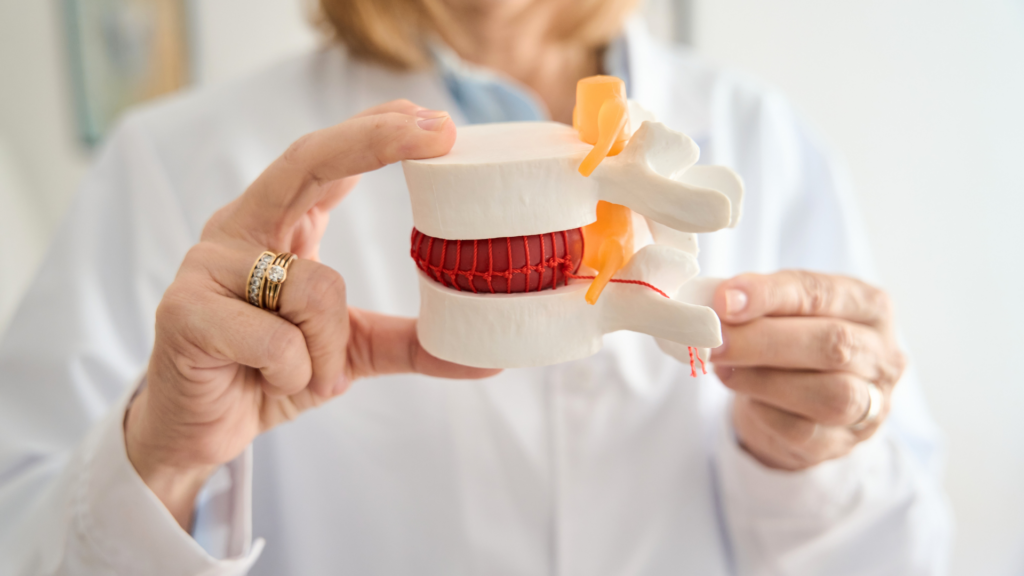
As we age, many parts of the body naturally change- including the spinal discs that cushion the vertebrae. Our hair turns gray, many of us lose our close up vision, and the discs in our spine begin to degenerate. Our spinal discs act as cushions or shock absorbers between the bones in our spine. This age-related breakdown of the spinal discs is commonly referred to as degenerative disc disease (DDD), although it is more accurately considered a degenerative condition than a true disease. We can dye our hair and get reading glasses, but can degenerative disc disease be reversed?
Definition of DDD
The discs in our spine allow us to move in many directions and remain flexible. The degenerative process is most noted in the lower part of our back, called the lumbar region, and the neck area, or cervical region, since these are the areas under the most stress. As discs lose height and flexibility, they absorb shock less effectively, which can contribute to stiffness, reduced mobility, and pain in some individuals. Degenerative discs can also occur due to injury.
Our discs are 80% water, which helps the collagen within the disc to maintain flexibility. As DDD progresses, the ligaments surrounding the discs become brittle. In addition, the gel-like center of our discs begins to shrink and thin. Some of us are left with degenerative arthritis.
Some Causes of Pain with Degenerative Discs
By age 60 most of us have some degree of DDD, but not all have pain. Pain is not caused by disc degeneration alone. Symptoms often develop when degeneration leads to one or more of the following:
-Loss of disc height, reducing cushioning between vertebrae
-Small tears in the outer layer (annulus fibrosus), which may irritate nearby nerves
-A bulging or herniated disc that places pressure on spinal nerves
-Increased stress on nearby joints, leading to facet joint arthritis
-Narrowing of the spinal canal (spinal stenosis)
Can Degenerative Disc Disease Be Reversed?
Unfortunately, you cannot reverse degenerative disc disease, but you do have other options to reduce pain and enjoy your life.
Begin by losing some weight if you are overweight, stop smoking, maintain good posture, and avoid activities that put stress on that area of your back.
Physical therapy can help relieve symptoms, as will anti-inflammatory medications. Steroid injections are another option, along with nerve blocks and radiofrequency nerve ablation for longer-lasting relief.
Some patients may also explore regenerative medicine approaches such as platelet-rich plasma (PRP). Stem cell therapies continue to be investigated, but evidence remains limited and these treatments are not considered standard of care for degenerative disc disease.
If these provide no relief, surgery may be the last option.
Frequently Asked Questions
Can degenerative disc disease be reversed?
No. Disc degeneration cannot be undone, because the discs do not regain the water content and elasticity they lose over time. The pain it causes, however, can often be managed well with non-surgical treatment.
Is degenerative disc disease really a disease?
Not exactly. Despite the name, it is a normal age-related change rather than a progressive illness. Most people develop some disc degeneration by age 60, and many never have symptoms at all.
Does everyone with DDD have back pain?
No. Imaging often shows disc degeneration in people with no pain whatsoever. Pain usually appears when a dried-out or cracked disc irritates a nearby nerve or shifts stress onto other structures in the spine.
What makes degenerative disc pain worse?
Symptoms often flare with prolonged sitting, bending, twisting, or lifting, and may ease with walking or changing positions. Smoking and excess weight can both accelerate disc degeneration.
Can DDD be treated without surgery?
Yes. Most patients are managed successfully without an operation using non-opioid, minimally invasive treatments such as epidural steroid injections, nerve blocks, radiofrequency ablation, and PRP therapy, combined with activity and lifestyle changes.
When should I see a specialist?
Make an appointment if neck or back pain lasts more than a few weeks, keeps returning, or limits your daily activity. Seek care promptly for numbness, weakness, or pain radiating down an arm or leg.
Schedule an Evaluation in Marlton, NJ
If chronic neck or back pain is interfering with your daily activities, Dr. Sonal Patel and the team at Ram Wellness Group can help identify the source of your pain and develop a personalized, treatment plan.
Call 856-387-7027 or request an appointment to visit our office at 750 Rt 73 S, Marlton, NJ 08053.